*** TRIGGER WARNING: This article discusses weight-loss drugs, body image, eating habits, and related health topics. If you or someone you know is struggling with an eating disorder, support is available through the National Eating Disorder Association***
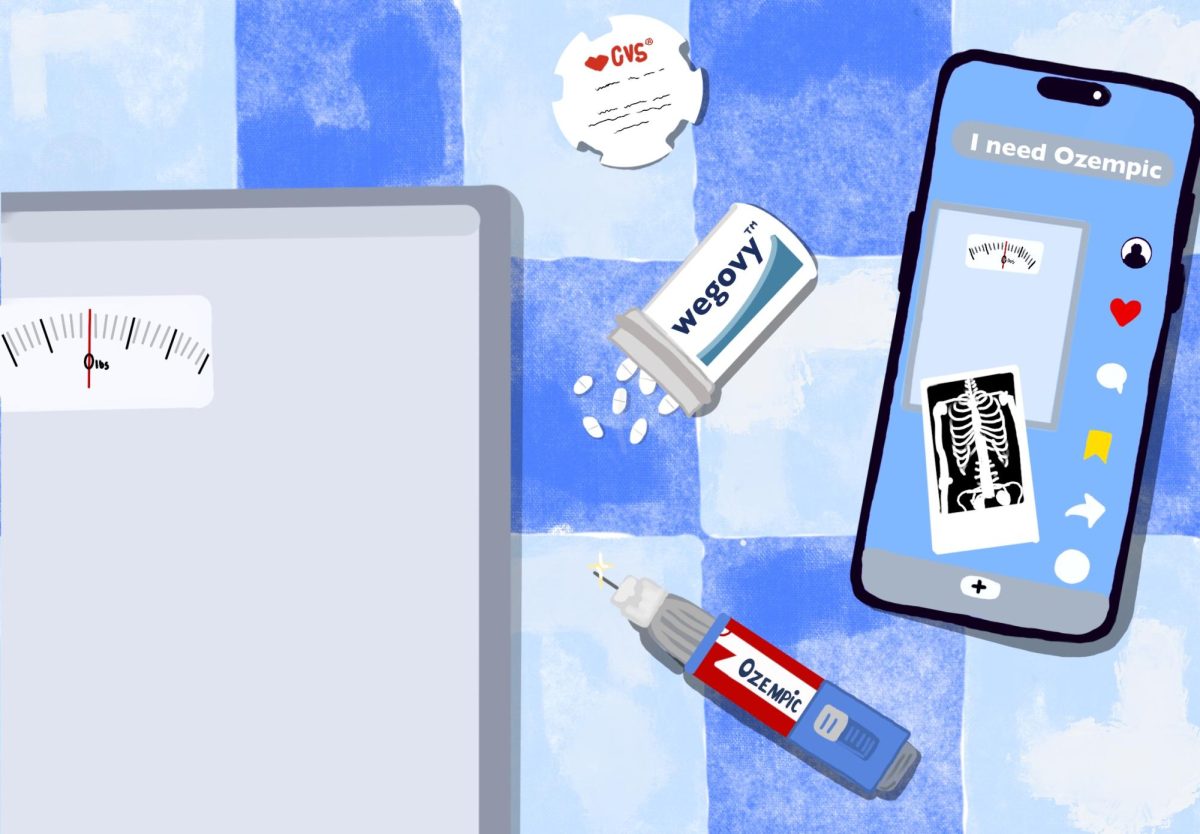
Scroll through your phone on any given day, and you will find it: a before-and-after video. A reel of someone lifting their shirt to reveal a flatter stomach with a caption promoting a weight-loss medication. Ozempic, Wegovy, and Mounjaro are common weight loss drugs that many know through social media and friends. I can think of 10 of my teenage friends who are on weight loss drugs, and many others who are looking into how to get on one. My friends are just one example of a larger trend in the U.S., according to a KFF poll from late 2025: one in eight American adults is currently on a glucagon-like peptide-1 (GLP-1) drug. That’s more than 30 million people, and the number is only going up.
GLP-1s were developed to treat type 2 diabetes. They work by mimicking a hormone the body produces to regulate blood sugar and hunger. They are, by many clinical measures, genuinely effective for the patients they were designed for.
However, the way we have embraced these drugs has almost nothing to do with health, and the people paying the steepest price for these drugs aren’t adults who know what they’re signing up for; they’re teenagers. Medication has become a culture, and these drugs are being used for the human desire to take up less space.
I think people want to believe that there was a real shift in body standards because of body positivity movements, but I don’t agree with that. The body positivity movement, beginning in the 2010’s, promised a real change: after decades of thigh gaps and size zeros, culture was finally pushing back. Bigger bodies were on runways, diet culture was called out publicly, and self-acceptance was the new standard. But even with all this progress, thinness never stopped being the goal. What changed was how people got thin.
The ’90s gave us heroin chic. The early 2010s gave us Tumblr and thinspo and pro-ana content packaged as an aesthetic, and eating disorders packaged as a personality. Pro-ana and pro-mia are trends promoting anorexia and bulimia, which are eating disorders, very popular among teenagers because they were promoted as a goal. The public conversation shifted, people became uncomfortable talking about how they lose weight, but underneath it all, nothing actually changed; the internal voice most women I know carry around with them never changed either.
These drugs have been “increasing the weight of the pressure to pursue thinness,” as Time writer Catherine Mhloyi explained in a recent article. I have a different perspective: Ozempic didn’t bring back the obsession with being thin; it just made it easier to act on that obsession and to justify it. Now, instead of saying, “I’m on a diet,” you proudly say, “I’m on medication,” and somehow that makes it okay.
But it isn’t. It’s the same obsession, just medicalized.
There’s a part of this interest in weight loss drugs that should alarm everyone, but largely doesn’t: this is no longer an adult trend; it is a teenager’s. This is spreading through schools, it’s the topic of casual conversations, and it’s being promoted as self-improvement and self-love.
GLP-1 prescriptions jumped 700% among young people between 2022 and 2024. Among children 14 and younger, use rose 84.6% in a single year. These aren’t just kids with diabetes. These are kids who have absorbed the idealization of being thin through TikTok, Instagram, and most importantly, the conversations adults have in front of them. The mom who tells you to cut all of that sugar crap because you’re “getting too big.” The aunt who is always on a diet. The relative who is complimenting that one cousin’s weight loss. Teenagers are listening to all of it, learning what gets praised and what doesn’t. And what gets praised, is overwhelming, is being smaller. Because of those influences, teens believe that their bodies are problems and that this drug is the solution. Videos tagged “#Ozempic” went from 2 million TikTok views in 2021 to over 1.2 billion in 2023. This is a medical and cultural concern. The algorithm serves this content to everyone, including teens and young children, who shouldn’t be exposed.
Education Week found that nearly 90% of teenage girls say they feel pressure to be “pretty,” and in 2026, pretty is increasingly just a synonym for thin. School counselors are describing a ripple effect they haven’t seen before, explaining that the normalization of Ozempic in teen culture is “outpacing their ability to respond.” I believe it. When a student watches a classmate visibly shrink over a semester and finds out it came from a drug, they don’t think about the medical side effects. If a student sees their classmates talking about weight and significantly dropping it before important events like birthdays, prom, and graduations, they think about how to get the same look, and they know how to find the drug that will “help” them.
Teens who want weight loss drugs but can’t afford them or access them legitimately are left turning to illegal channels to get them, and those channels are genuinely dangerous. A CNBC investigation exposed a full underground economy of counterfeit weight-loss drugs, and about 42% of online pharmacies selling semaglutide operate with no license. These products are often extremely detrimental to teen health. But even for the teens getting the real thing, the most pressing health issue these drugs create isn’t physical. It’s what it does to their mind.
GLP-1 reinforces harmful messages about body size and self-worth. The appetite suppression these drugs cause is clinically nearly indistinguishable from the restriction that defines eating disorders. These drugs can trigger or worsen disordered eating, especially in undiagnosed people. For a teenager who is already vulnerable, that is an incredible thin line to walk.
We’ve spent years trying to convince teenagers that their bodies weren’t problems through the body positivity movement. Now we’re selling them a drug that says otherwise.
There’s a $190 billion industry projected by 2035 that depends entirely on people believing their bodies are problems to be solved. It has every interest in framing weight loss as self-care and the responsible choice, and we still wonder why so many people, especially teenagers, feel unaccepted and insecure in their own skin.
It’s the belief — taught young, reinforced constantly, and now being literally injected — that you are too much, and that being physically less would finally resolve that problem.
However, it won’t. It never did, and we must stop pretending otherwise.