At the end of April, the United States was notably excluded from a week-long international climate discussion in Santa Marta Columbia, where many world leaders gathered to discuss moving away from fossil fuels in order to address the rapidly accelerating climate crisis.
Leaders at the summit criticised wealthy nations for continuing to prioritise fossil fuel production while more vulnerable countries continue to face the consequences. This exclusion from one of the first global conferences built on expelling climate change shows global frustration with the United States’ abandonment of climate leadership, especially after February 12, 2026, when President Donald Trump and the United States Environmental Protection Agency (EPA) announced a sweeping rollback in U.S. climate policy by declaring that the 2009 “endangerment finding” is now invalid.
This scientific finding had previously concluded that greenhouse gases like carbon dioxide and methane are a direct threat to public health and welfare, forming a legal basis for federal climate regulation under President Richard Nixon’s Clean Air Act, signed in 1970. This finding became the legal foundation for EPA Climate regulation after 2009, when the agency formally determined that greenhouse gases endanger public health under the Clean Air Act.
By eliminating this determination, the current presidential administration has effectively removed the federal government’s ability and authority to regulate greenhouse gas pollution and, in turn, fight climate change as a whole. When the president announced the decision, he said that the scientific finding had “no basis in fact ” and “no basis in law,” despite the finding having been a result of the 2007 Supreme Court decision of Massachusetts v. EPA, which ruled that the EPA could, in fact, regulate greenhouse gases from motor vehicles.
Trump’s rollback in February, however, came as no surprise, because it aligns with Trump’s environmental policy; during his first term, he also withdrew the United States from the Paris Climate Agreement, one of the largest environmental conventions in the world. (Biden rejoined during his term, and then Trump withdrew again.) Trump has long expressed skepticism toward climate science and research from the EPA, and according to The New York Times, he once even called climate change “the greatest con ever perpetrated on the American people.”
Supporters of the rollback argue it reduces government regulation and helps industry and, in turn, the U.S. economy, aligning with the “America First” mentality that the Trump administration had pushed.
In contrast, many scientists and environmental experts warn that by removing these regulations, decades of climate policy and protections will be undermined. Research from the EPA shows that Clean Air Act regulations have significantly reduced pollution while generating economic benefits that far exceed their regulatory costs.
The consequences of weakening environmental protections extend far beyond politics and will definitely affect millions of people around the world. Climate change is already intensifying extreme weather events and processes such as heat waves, floods, cyclones, droughts, and storms, which threaten communities and public health. According to research published in The Lancet, all modern types of pollution have contributed to about 9 million deaths worldwide every year, making it one of the largest environmental threats to human health. Countries worldwide already demonstrate the human cost of pollution and climate change. For example, Pakistan experienced catastrophic flooding in 2022 that displaced millions of people. Alongside India, which continues to struggle with extreme monsoon flooding and dangerous extremes that destroy infrastructure and many public health systems. Meanwhile, in the United States, climate-driven disasters are being intensified by fossil fuels, such as wildfires, hurricanes, and heat waves, which already cost tens of billions of dollars each year and threaten the health and safety of millions of people.
Environmental regulations, especially in the United States, were originally designed to prevent these types of ramifications. Limiting greenhouse gases reduces air pollution, slows global warming, and protects communities from severe climate-related disasters. This is specifically significant for the United States, considering that, according to Climate Trace, it is the second largest emitter of greenhouse gases in the world, with 38.45 billion tons of CO2 since 2015, amounting to 12.64% of emissions around the world. As the world’s most industrialised country and one of the biggest contributors to global pollution, the United States holds an enormous responsibility in addressing climate change.
As one of the world’s leading superpowers, the United States often shapes global environmental policy. Weakening climate protections and regulations can signal to other governments, especially in developing countries already suffering the worst effects of climate change, that addressing pollution is not a priority. In many ways, it can feel as though wealthy nations are neglecting the responsibility that comes with their emissions and pushing the implications of those issues and decisions onto countries that have contributed far less to the problem. The influence also extends to global climate negotiations, where U.S participation often determines how ambitious international agreements become. When the U.S. steps back from climate leadership, it can weaken global cooperation frameworks such as the Paris Agreement by reducing pressure on other major emitters.
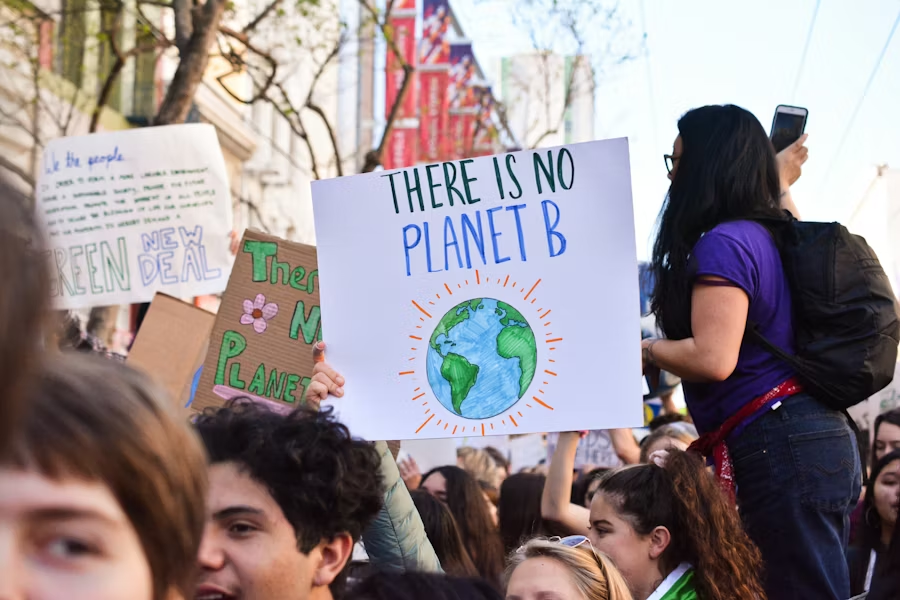
As a young person, decisions like this feel particularly alarming, since rollbacks of climate protections under the current administration represent a major step backwards. My generation will grow up, build careers, raise families, and try to create stable lives in a world that will face rising sea levels, extreme heat, and disappearing ecosystems. If meaningful action is delayed during critical years — when we have a chance to reverse some of the effects of climate change — scientists and experts will find it much harder to limit global warming and save the planet and our health. Watching these older generations make the decisions that will shape a world they may not live to see and feel the effects of raises serious concerns about responsibility in our leadership.
If the federal government steps away from leading climate action, responsibility must shift to communities, students, scientists, and individuals. Addressing climate change is not only about national policies or international agreements, but it also requires education and awareness. Many people dismiss climate change because they believe it does not affect them personally. In reality, it affects our health, water supply, and food systems, as well as our economic stability. Raising awareness, supporting cleaner energy, reducing pollution alongside overconsumption, and educating yourself and your communities about the real impacts of climate change are essential steps individuals and our society can take.
Ultimately, the choices we make today will shape the earth that the future and current generations will inherit. By ignoring deregulation around climate change, the consequences of this issue will only worsen, but if we confront the issue head-on as a society, we can still protect the people and planet for years to come.