For many students, the convenience of free menstrual products has recently been overshadowed by a different concern: comfort and ease of use.
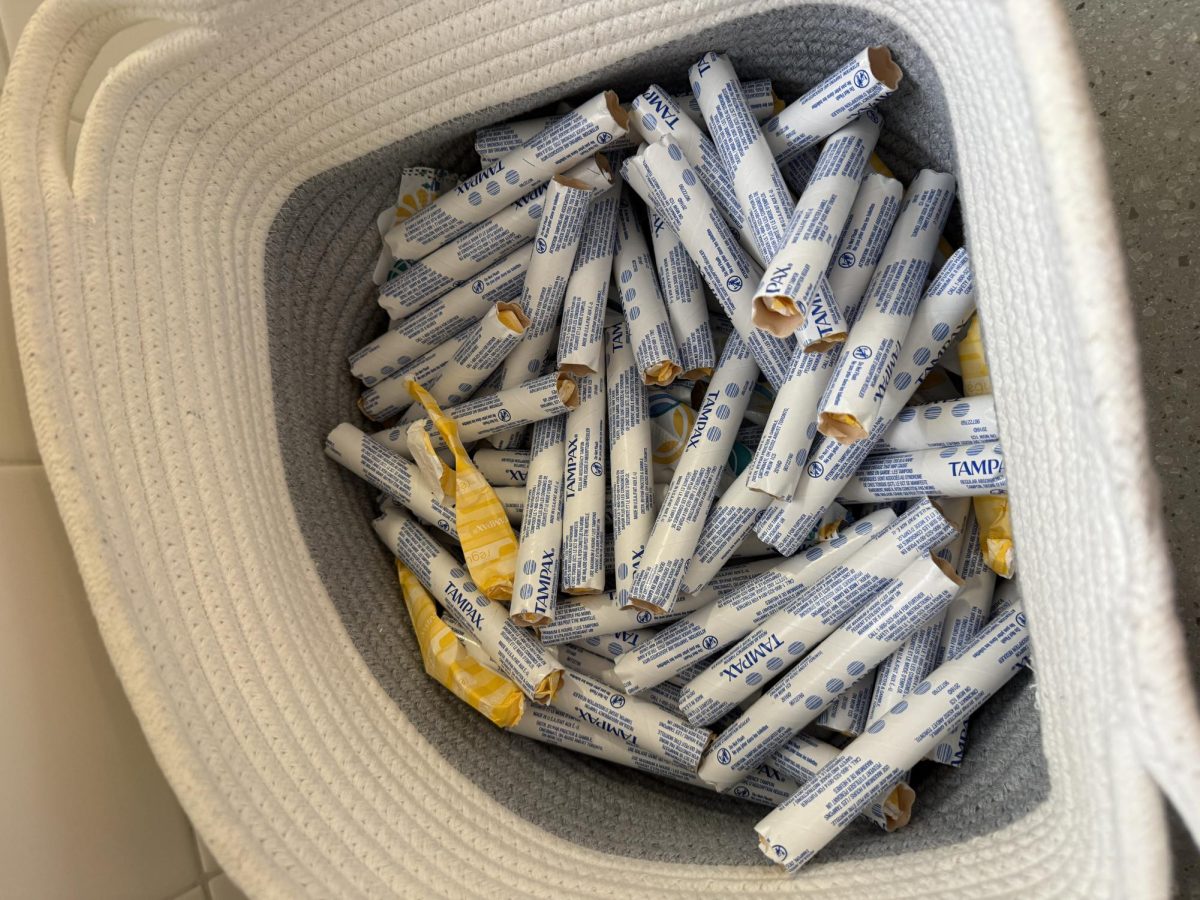
Since MFS’s implementation of free menstrual product baskets five years ago, the school has not only changed the type of menstrual products provided but has also cut back on the variety of options offered. Multiple students have raised concerns in Agenda, expressing how these new cardboard-applicator products are uncomfortable and difficult to use.
New products and inconsistencies of restocking have affected students’ ability to rely on these resources during the school day.
Beginning this initiative in 2021, MFS was ahead of the curve, as the New Jersey Legislature only passed a law requiring public schools in the state to provide free menstrual products to students in grades 6-12 in 2024.
Alum Haila Desai, former Agenda and Diversity clerk, first took notice of the need for better menstrual care and once she became Agenda clerk junior year, Desai pushed further for menstrual care and was even lent the school credit card to buy products that would benefit the community.
“I knew the school had more money to put toward this initiative and believed our students needed better products,” Desai said.
With support from the Agenda Committee and Gender Inclusivity Forum, Desai and others helped push for a wider variety of more modern and comfortable products to meet different students’ needs. However, once those students graduated, the school saw a decline in modern products.
Olivia Martin ’27 spoke on issues regarding her personal experiences dealing with limited product availability and what she wanted changed.
Martin stated that having limited access to the type of supplies she uses has affected her school days, and stocking up regularly is more beneficial than many may think.
“Some of the products are old and outdated, and still have cardboard applicators for tampons, which is not comfortable, and some of the old products aren’t great,” said Martin. “Getting more updated products as well as a wider variety of options because people have different needs would be especially helpful,” she added.
Sanaa Rodwell-Simon ’28 agreed that the current selection didn’t meet different needs and comfort levels, particularly in the main building, given the limited supply.
“I don’t think the selection meets different needs, as what I have seen from past weeks in the main building, the period supply box has mainly only had tampons, and I haven’t seen a pad for a month,” said Rodwell-Simon.
Director of Wellness and Student Services Dr. Susan Batastini highlighted access to menstrual products as an important aspect of student wellness and academic success.
“When students don’t have reliable access to these products, it can become a distraction during the school day and impact their ability to focus in class,” Batastini explained.
She emphasized that menstrual care should be treated as a basic necessity, adding that “students should be able to rely on these resources without worrying about whether they will be available when it’s needed.”
Similar concerns were echoed by other students to Diversity and Agenda clerks. Agenda Clerk, Emmie Huynh ’27, explained that she and co-clerk Ali Sabir ’26 have heard students’ thoughts about the issue.
While the Agenda clerks aren’t provided with money for funding these issues, they “spoke to the business office and talked to them about getting higher quality products and how [the products are] a necessity for students to have access,” Huynh explained.
The agenda clerks don’t see a resolution by the end of this year, but are hopeful to reach one early in the new school year.
After hearing the student perspective on the menstrual products, Chief Financial and Operating Officer Dawn Eaton explained the process of the products they distribute and shared the next steps on overcoming this issue.
“We buy products in bulk, so there is a lot we need to use, but the idea is when we use the rest of these products, we will look for alternative ones, so when we purchase for next year, we will look into accommodating different students’ needs,” Eaton said