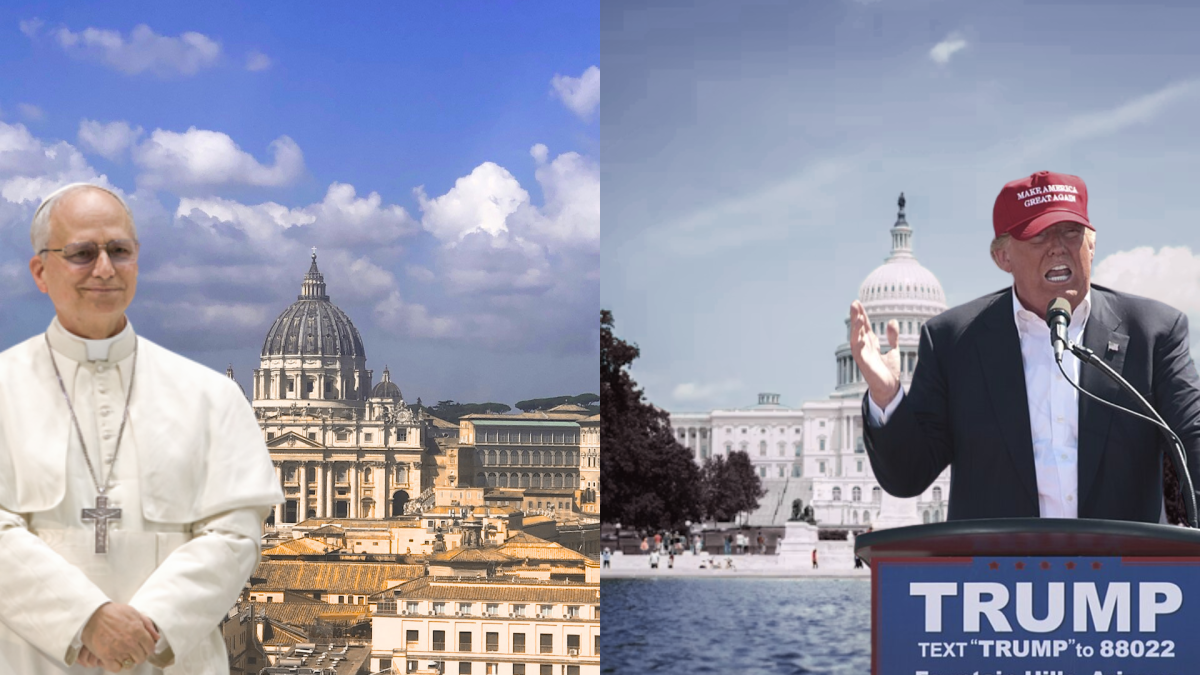
Recent ideological rifts occurring between President Donald Trump and Pope Leo XIV, the first American-born Pope, have impacted Christian students at MFS, both politically and personally.
The Pope has been a critic of President Trump on many issues, particularly regarding the legality of abortion and foreign policy. But recent tensions over the Iran War, specifically regarding U.S. military strikes have significantly exacerbated these existing tensions.
In one particular instance, US secretary of defense Pete Hegseth asked Americans to pray for a U.S. Victory in the Iran War “in the name of Jesus Christ,” sparking backlash from the Holy See.
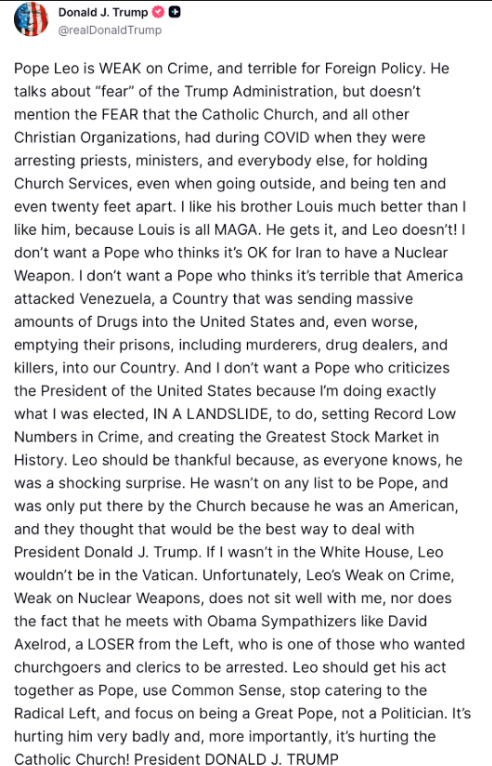
Additionally, sparked by the Pope’s statements on the 2026 Iran War, President Trump released a barrage of statements against the Pope, calling him “weak on crime” and “very liberal.” Trump himself identifies as a non-denominational Christian, though there is significant debate over the degree of his devotion.
Being a devoted Catholic, Vice President of the United States JD Vance has defended the President in a Fox News interview stating, “We’re … going to disagree on substantive questions from time to time. I think that’s a totally reasonable thing.”
Tension escalated when President Trump posted an AI-generated image on X (formerly Twitter), which many perceived to be a depiction of the president as Jesus. The president swiftly deleted the post and defended himself saying that it was meant to be himself depicted “as a doctor.” Regardless, many still interpreted it as a portrayal of himself as Jesus, considering the post to be distasteful.
Leo Male ’28 is a Roman Catholic student at MFS who frequently attends Christian Student Union (CSU) affinity group. When asked what he thought of the photo of the president, he said that “[it] kind of offends me as a Roman Catholic. I’m passionate about my worship of Jesus and to mock him offends my religion.”
Maxwell Parchment ‘28 is a non-denominational regular attendee of CSU. While acknowledging that he is not Roman Catholic, he said, “I do see that in the words [of the president] I can see some ‘disrespect’ to Christianity/Catholicism as a whole.”
On May 7, 2026, Secretary of State Marco Rubio visited the Vatican. Given Rubio’s status as a devout Catholic and more moderate member of the Trump Administration, this was widely viewed as a way to cool tensions between President Trump and Pope Leo XIV. After his meeting with the Pope, multiple outlets reported that the relationship between the US executive and the Holy See had been “reset” to an extent.
Dan Zemaitis, Chester Reagan Chair and MS/US Teacher for Quaker and Religious Studies at MFS, spoke about whether he believed there had been a significant change since the meeting at the Vatican.
“I don’t think so. I think that the Pope has a pretty strong opinion, and he’s not afraid to say that. I think the president obviously has a pretty strong opinion, and he’s not afraid to say that. I think that visit [had the intended purpose to] help. I don’t know how much it did,” said Zemaitis.
“Typically speaking, from everything I know, the Pope and the president sort of let each other have their own purviews. As a country we typically try to separate church and state and the Pope is responsible for the religious life of Catholics. The president is responsible for political life in the country and they don’t typically get into too many disagreements,” said Zemaitis.
While disagreements between the US president and Pope are not uncommon, there has been an unusual amount of tension between the current Pope and president. Despite their differences, Trump himself met with Pope Francis during his first term to discuss immigration and environmental policy. As of writing, the 47th President has not met with Pope Leo XIV.
“Now that’s not to say there haven’t been times when [disagreements have] happened, but for the most part they’re pretty separate.” Zemaitis said, “And they don’t have a ton of connection between one another in terms of that. Oftentimes there’s something that both sides agree upon. They may work together, and typically the relationship’s been pretty respectful. “
An example of collaboration between the Holy See and the President of the United States occurred on June 7, 1982, when President Ronald Regan and Pope John Paul II met in the Vatican, both united by mutual distaste of Communism.
When asked about what he believed the effect would be on Roman Catholic Americans, Zemaitis said, “I think it can be tough for most American Catholics. I think that there has always been tension there. There have only been two Catholic presidents: Kennedy and Biden. When Kennedy was elected, there was real fear that he would be more beholden to the Pope than to America. Those were pretty unfounded. I think that was something that people overblowed.”
Zematis continued, “I think it can be hard for folks to have to square when their spiritual leader is maybe in disagreement with their political leader.”
Zematis added, “It could cause some Catholics to distance themselves from Trump. It could also cause some Catholics to distance themselves from the Pope. It’s a little unclear what will happen, but it may also not have a huge effect one way or the other.“