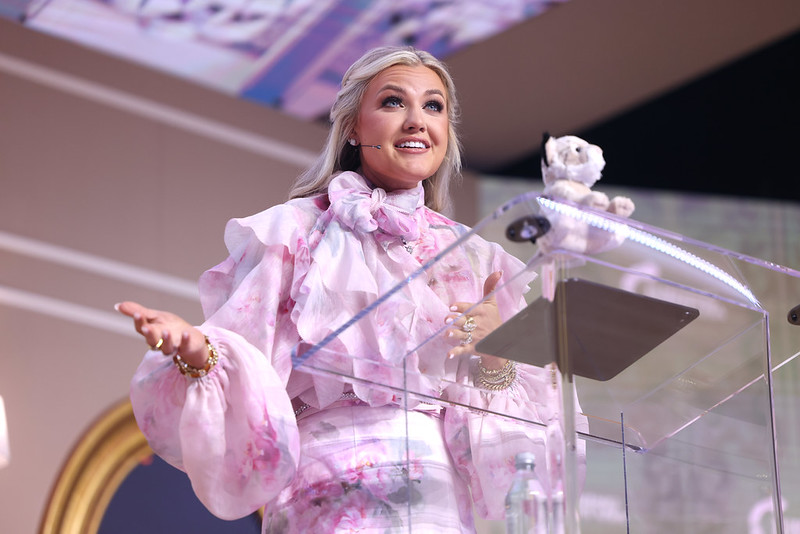
On September 18, 2025, Erika Kirk assumed the role of CEO of Turning Point USA following the death of her husband, Charlie Kirk. In her new role, she has hosted multiple campus tours, conducted panel discussions, and attended summits, garnering much internet attention for not appearing to be in active grief. The internet response to Kirk’s display of mourning is almost inherently misogynistic and may potentially be damaging to women and their ability to freely express their emotions without accusation of being manipulative or cold-hearted.
After her husband’s death, the first piece of criticism directed at Erika Kirk’s grief was her decision to become CEO of Turning Point shortly after Charlie Kirk’s death. Podcaster Jennifer Welch called Erika Kirk a “grifter,” a term for someone who exaggerates, fakes, or manipulates their political views to gain monetary or influential benefits. Welch also said, “Women are a lot more empathic than [Erika is].”
Internet users on platforms like TikTok, Instagram, Reddit, and Facebook have also shared the same sentiment that Kirk exhibits a lack of care for her husband’s death. One comment from user @prxncess.sleep has 36.7 thousand likes on a video criticising Kirk’s behavior reads, “She’s not even in mourning black.”
Such responses seem like a direct continuation of the culture that contributed to the Victorian prescribed periods of mourning. In Victorian America, women were expected to follow a very rigidly defined set of rules that limited their attire and actions. Specifically, women were expected to veil, not go outside for a set period of time depending on what family member they lost, not wear jewelry, and not even speak.
The main concern I find is that if the opposite were to have occurred, and it were a man who lost his wife instead, the man would almost certainly not get the level of backlash that Kirk has received for not putting her grief on full display and seemingly putting on a brave face for her work. In fact, this man would likely be applauded.
According to a study on the varieties of grief experiences, many people experience grief in ways that are “relatively more proscribed period of time,” which may raise doubts for others on whether they are “hiding something.”
My defense of Kirk’s mourning does not diminish her controversiality, though. Kirk’s role at Turning Point USA is harmful to young women in America and the centuries of feminism that gave women in this country the very privileges and freedom that she wants to get rid of.
Kirk’s connection to Charlie Kirk’s harmful speech and rhetoric hinders many, even those who claim to be progressive, from understanding the implications of such blatantly misogynistic comments. I believe that the continuation of such expectations of women may set the stage for careless dialogue regarding gender and sexism on the internet and even in person.