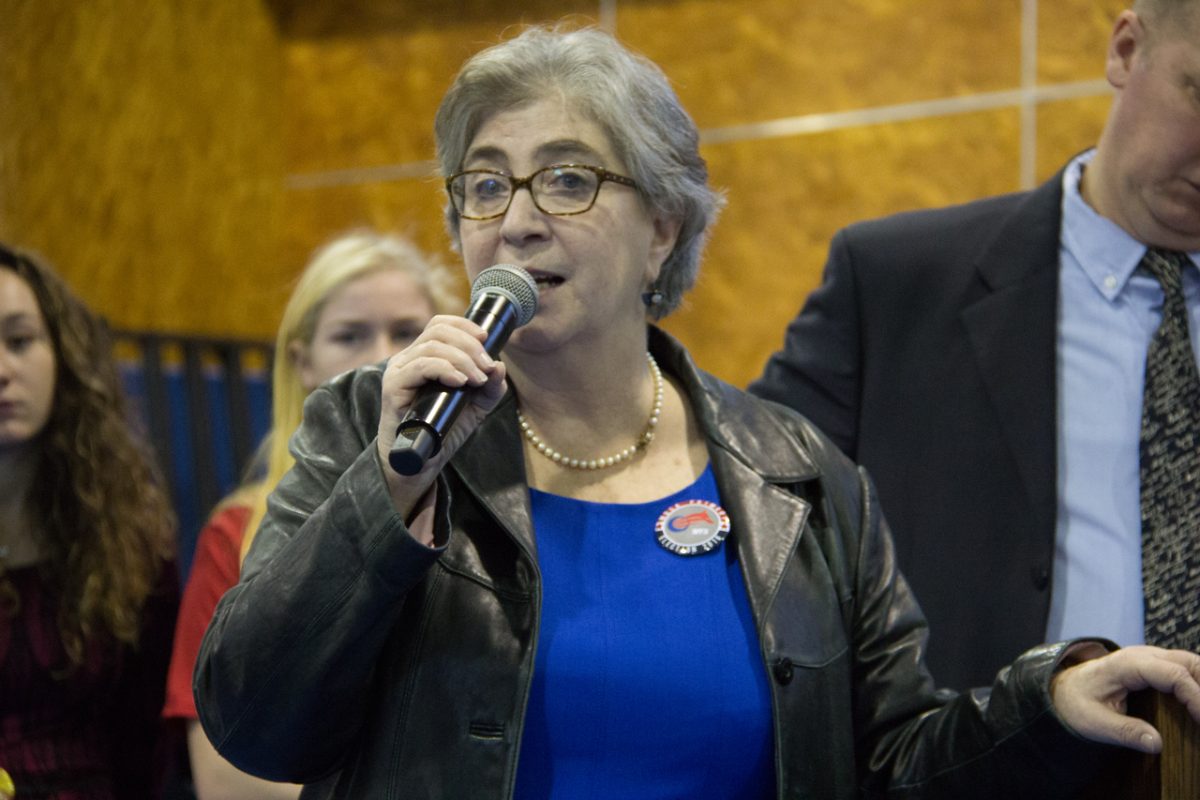
Judy van Tijn, a former US history teacher who retired in 2018 from Moorestown Friends School, was invited to teach a section of eleventh-grade World Religion during the third quarter. During her time at MFS, van Tijn served as the US Service Coordinator and created the US Service Committee. Additionally, van Tijn led the Mock Primary Election before the tradition in its original format was discontinued.
Van Tijn recently spoke with WordsWorth about carrying important lessons and memories from her time teaching at MFS to a new generation of students. She shared more about her past experiences at MFS, her recent endeavors in retirement, and her plans for enjoying her new role back in the Upper School.
Note: This interview has been edited for length and clarity.
WordsWorth: When and why did you first start working at Moorestown Friends School?
Judy van Tijn: I think it [was] either ’91 or ’92. I worked first at Mullica Hill Friends School, and we had a high school, but it got smaller and smaller, and ultimately it had to close. We had four seniors and maybe four juniors left, and we put out word to all the local [Quaker Friends] high schools to ask them if they would take our students, because we wanted to place them. The head of Moorestown Friends School at [the] time, Alan Craig, said that they would take anybody who wanted to come. At the same time, I needed a job, so I came in for an interview, and they hired me. [For] my first two years, I taught middle school English. I’m a dreadful middle school teacher.
WW: Why did you switch from middle school to high school?
JvT: I had started out teaching college, [and] middle school was a bad mistake. I’m much better suited to the older students. I’m sure all my students were fine, if you ask them. You can check with [current MS/US Religion Teacher and Chester Reagan Chair] Dan Zemaitis; he had me in seventh and eighth grade. I’m sure it was fine, but it was not my sweet spot for teaching.
WW: What was your official role in the Upper School during your first term [at MFS]?
JvT: I did several things. My academic assignment was always history. I did teach World Religion classes. When I first came here, they had the same system that they have now, with the seminars, but we had trimesters. So juniors and seniors took three seminars, and all juniors took the same seminar [in] the last trimester called International Relations. I always taught ninth, eleventh, and twelfth [graders]. I never taught tenth because, when I was here, tenth was American history, and I have not had an American history class since 1970. My doctoral fields were in European and Ottoman history. I was the Upper School Service Coordinator for 12 years. I restarted service trips that had been let go, and I ran the Mock Primary election.
WW: What are the differences between MFS now and the last time you taught here?
JvT: Well, I think the kids are pretty much the same. You know, when you’re out and about in the world, people don’t really like teenagers very much. There’s all this sort of nonsense in the system about, ‘oh, they’re dreadful, blah, blah, blah,’ but I find my students to be well-informed, very pleasant in class, and I would say, relatively similar, seemingly, to the kids that I taught when I was here.
WW: What about curriculum-wise?
JvT: The curriculum has changed substantially since I was here, for, I’m sure, very good reasons. So, for example, tenth grade was American history, ninth grade was nineteenth-century world history, eleventh grade was 20th-century history, which I taught, and AP US History was an eleventh-grade class. They had an honors history [class] for the regular 20th-century history.
WW: What are your favorite parts about being back on campus?
JvT: I love to see my old friends. I’m so happy to see many of my former students teaching here and doing it so well. I am thrilled to be back with kids again, teaching again. It’s really fun!
WW: What have you done in the “between” time since coming back to MFS?
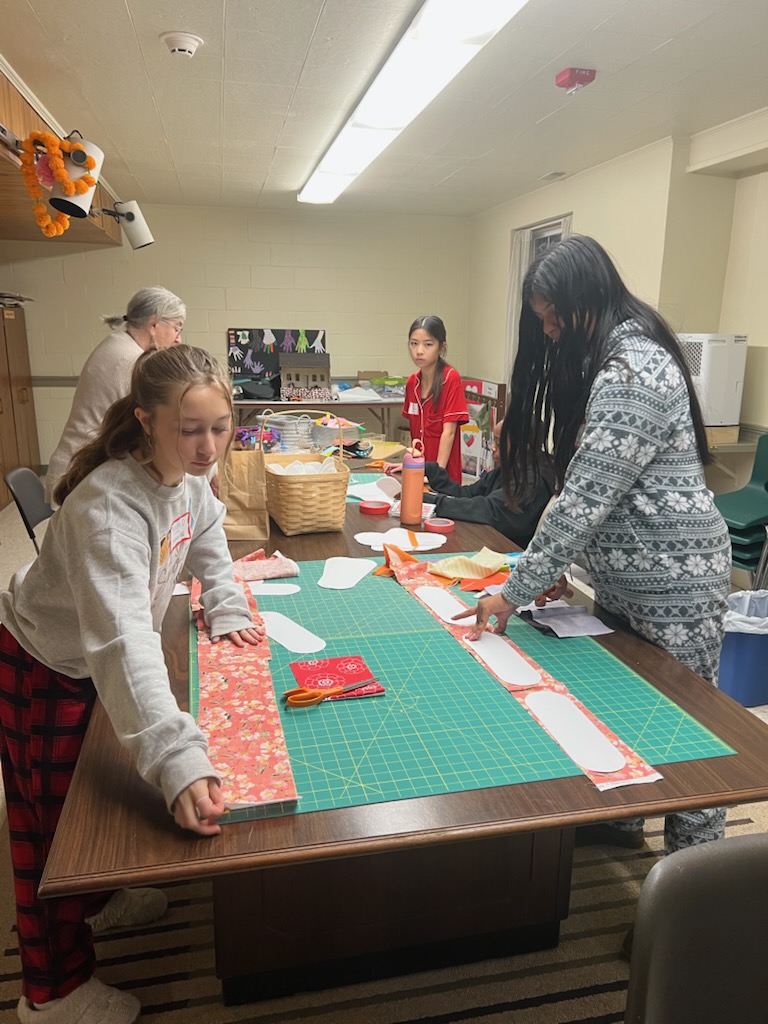
JvT: I feed feral cats twice a week, over 100 of them. I [also] work on PASHI; we make reusable menstrual pads, and we send them to places like Benin, Haiti, Jamaica, and other places like that. This is really a passion of mine. [These] girls don’t go to school [after] middle school, [and] there’s no other thing they can do. There [are] no electronics, there’s no distant school, so if you think about that over time, [it] means that a lot of girls don’t finish school. So, our motto is, ‘every girl in school every day,’ [and] I’m very involved in that. I have [also] done some political work over the years. I write, I help look after a friend of mine’s grandkids — I do about five or six different volunteer things. According to my husband, I’m never home!
WW: Your volunteering and teaching experiences are very inspiring. What do you want your students to take away from them?
JvT: I was head of service, and I believe two things; one, it should be student-led, and I’m thrilled to pieces that Dan Zemaitis is working on that. [The second thing] is that [service] should always be fun, because the only way you build the habit of service is by making it something that speaks to the people who are doing it. For school, I always hope that my students learn something, that when they’re done in my class, they’ve learned something. I wouldn’t always bet it’s the subject I’m teaching, [although], I hope it’s the subject I’m teaching! But, when they get older [and] I see my students later on in life, it isn’t usually the French Revolution or the ins and outs of Christianity or Shinto that they remember. But, I hope that they learn something useful in my class, and I love to teach!
WW: What’s the schedule like for teaching a section of eleventh-grade World Religion? Do you come in every day?
JvT: I only come in for my classes, and then I sort of skip [around]. I could stick around if I wanted to, but I usually have some place to be and something to do. And, also, I live five minutes away, so I just walk in and walk out.
WW: After retiring in 2018, have you been regularly coming back to visit MFS?
JvT: You know, I worked for a little while [at MFS again]. I cataloged [the Alice Paul Archives] and put them into some kind of order for Steve Zakroff over in the Archives [Department], and I was doing archival work for him, so I was on campus a little bit for that. I keep up [with MFS] a little bit and stuff like that, but I sort of walked away because, if [MFS] is going to survive and thrive, it’s got to be able to change and become whatever it’s going to be without people like me, who’ve been around forever, sitting around like, ‘we used to do it this way, and we used to do it that way.’ So, I’ve kept my distance to some degree, but I was very happy to be invited back.