Eighth-grade students at MFS have been working with the Moorestown Monthly Meeting to create menstrual products for the Pan-African Sisterhood Health Initiative (PASHI) as part of their Ethical Leadership and Service class.
PASHI first came to the Meeting House and the Moorestown Monthly Meeting in May of 2025, with efforts led by Meeting Clerk and former MFS Science Department Chair Barbara Kreider.
As part of the class curriculum, based on Quaker values and learning, eighth-grade students were tasked with serving their local community in a hands-on manner. The class is run by Middle School Director Max Bogaert and Middle School Dean Nicole Weber.
According to former MFS history teacher Judy van Tijn, a lead contributor to PASHI at Moorestown Monthly Meeting, Bogaert reached out to PASHI about five to six weeks ago and asked if the eighth-grade could come over to volunteer. Van Tijn has worked with PASHI since May of 2025.
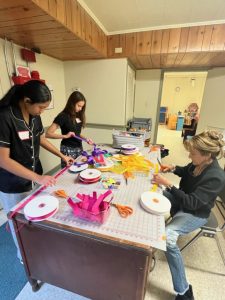
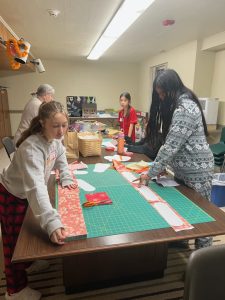
Since then, the eighth grade, split into two sections, has met every other Wednesday morning to participate in the service work at the Meeting House. The rotating schedule allows for a team of eighth-grade students to help PASHI for 45 minutes every week, contributing to the flow of menstrual pad production.
Eighth-grader Sophia Sevrin ’30 spoke on what they did for PASHI.
“We cut ribbons, we cut fabric, we sorted ribbons, put clasps on them, stuff like that,” she said.
Lauren Eickhoff ’30 added on, stating that they “just helped out with the small work behind making the pads.”
“It was fun,” said Eickhoff. “The people there were really nice, and it was pretty chill. It was relaxing.”
Reflecting on the service experience, Sevrin said, “It was interesting seeing what other people go through and how people helping can really make a difference in somebody’s life. I realized I take period products for granted every day.”
Van Tijn spoke on the importance of this type of service, distinguishing the eighth graders’ work from other forms of volunteerism.
“It’s very different from a lot of the service that students do in that it’s direct service,” said van Tijn. “What [they’re] doing is actually going to be the thing that goes to the delivery and is in somebody’s hands.”
“It felt good to know that we helped them,” stated Eickhoff. “They told us what happened [to the pads] afterwards, and it was nice to know where our work went.”
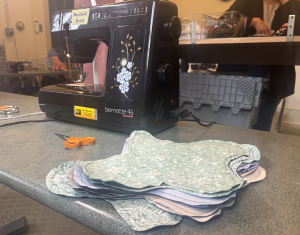
The period products made by the group have gone to girls located in America and internationally, helping women in Jamaica, Haiti, Ghana, and Kenya. Working with local churches, community centers, and schools in each country, PASHI has reached dozens of girls.
PASHI also focuses on menstrual hygiene education alongside donating period products to girls.
Van Tijn said, “We teach about menstrual hygiene, diseases, and other things like that.”
The non-profit is “particularly interested in supporting school-aged students who are missing school and other activities because they cannot afford menstrual hygiene products,” as stated on their website.
“The goal is ‘every girl in school every day,’” said van Tijn. “Educating women really does improve societies.”
According to the Moorestown Monthly Meeting PASHI website, “since December 2025, 950 Reusable Pads and 1010 Carrying Pouches” used to store both used and unused pads “have been made and delivered to Ghana” alone.
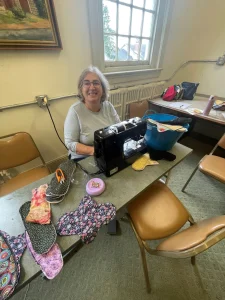
Currently, the Moorestown Monthly Meeting PASHI volunteer group meets every Wednesday from 10 am to 3 pm upstairs in the Meeting House. The group, working as a branch of PASHI Global, has partnered with other individuals and communities beyond Moorestown Friends, including the Bethlehem Church and local South Jersey “sewists” and “quilters.”