***SPOILER WARNING: THIS ARTICLE CONTAINS SPOILERS FOR THE FILMS “PROJECT HAIL MARY” AND “INTERSTELLAR.”***
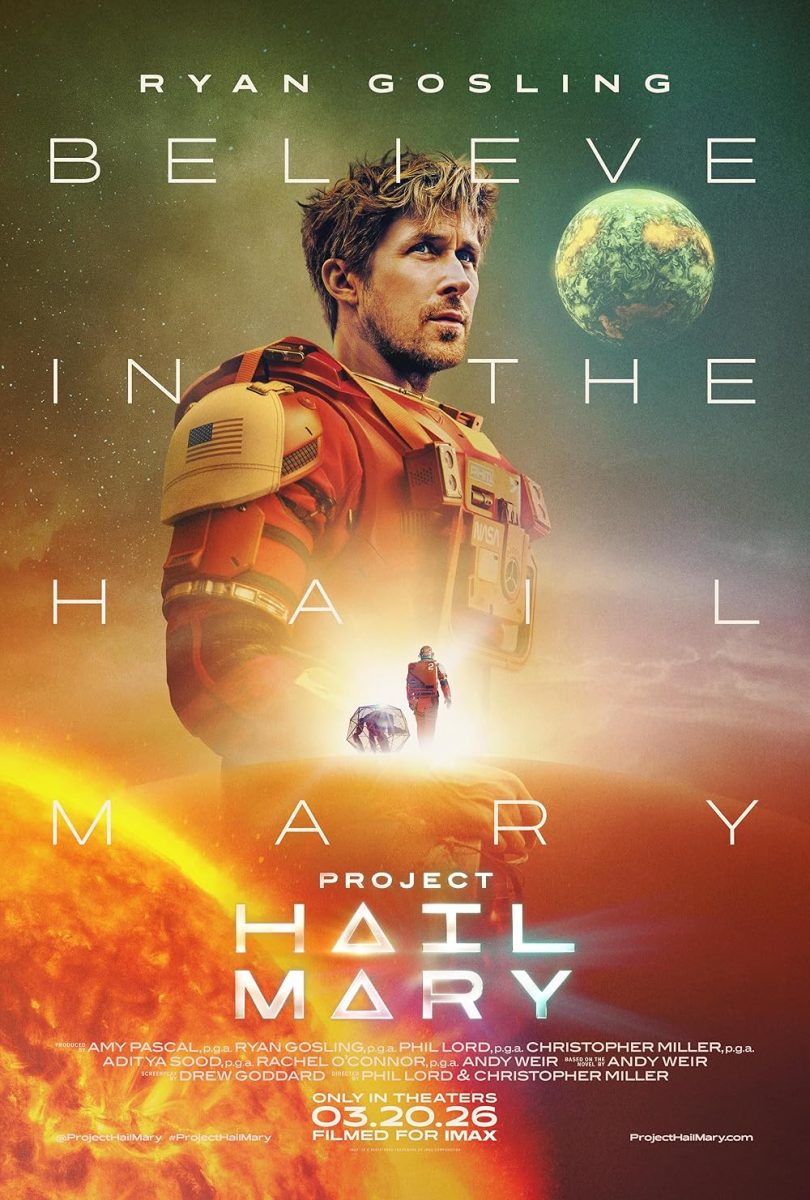
This year, “Project Hail Mary,” directed by Phil Lord and Christopher Miller, successfully adapted Andy Weir’s 2021 novel into an engaging, emotional science fiction (sci-fi) film masterpiece. The film was released in the United States on March 20, 2026, and received a whopping 94% on the Rotten Tomatoes “Tomatometer.”
The film follows Ryan Gosling as Dr. Ryland Grace, a former scientist, who finds himself alone on a spacecraft light-years away from Earth with no memory of how he got there. After Grace’s memory returns, he discovers that he is humanity’s last hope to stop an astronomical phenomenon known as astrophage from dimming the sun. As Grace journeys through space, he meets a rock creature that he names “Rocky,” who coincidentally had been sent from his planet on a similar mission. The two eventually break their language barrier and become an inseparable duo whose relationship the viewer can easily become invested in.
The already strong film turned into a fantastic one with its last-minute plot twist: after seemingly completing their mission and parting with Rocky, Grace discovers an imminent danger to which Rocky is vulnerable. However, Grace only has enough fuel to either return home or save Rocky. Grace ends up deciding to save Rocky, and the two return to Rocky’s homeworld, Erid. The film concludes with an ambiguous ending, as Grace indicates to the audience that he is contemplating staying on Erid as opposed to finding a way home to Earth.
Another aspect of the film that was very engaging was the non-linear plot. The movie juxtaposed scenes of Grace in space with a plotline of Grace before he left, so the viewers see the conclusion of his mission and the beginning of his mission consecutively.
Additionally, the movie was visually stunning. In particular, the scene where Grace was floating in space above the planet he named “Adrian” (after the character from the movie “Rocky”), the screen is engulfed with brilliant flashes of green from the planet’s surface and specks of red from the astrophage floating in space. In my opinion, this was the most beautiful and visually appealing scene in the entire movie.
Watching this movie as an avid sci-fi fan, however, one constant thought lingered in my mind: this movie is very, VERY, similar to “Interstellar.”
Directed by Christopher Nolan and released in 2014, the movie “Interstellar” also follows a reluctant astronaut who embarks on a journey through space as the Earth is dying, and the only solution is in the stars. Additionally, one particular scene from Project Hail Mary, in which Grace was outside his space shuttle dangerously collecting particles from the planet Adrian, felt extremely reminiscent of the famous “Docking Sequence” from “Interstellar.”
However, I believe that the movies differ largely in two particular areas. The first is where the emotional weight of the movies lies. In “Interstellar,” Cooper (the main character, played by Matthew McConaughey) is most emotionally connected to his daughter Murph, who is stuck on Earth while he is in space. This makes the fans extremely invested in Cooper’s journey home, as his main goal is to return to his daughter. However, in “Project Hail Mary,” the significant emotional connection that Grace has is to Rocky, who is present with him on his journey. Additionally, a major part of Grace’s character is his loneliness and lack of significant emotional relationships on Earth. For this reason, the viewer is less invested in Grace’s journey home than in his friendship with Rocky.
The second difference between the two films is that in “Interstellar,” the stakes felt higher. While there were some moments in “Project Hail Mary” where I felt stressed (such as the scene where Rocky almost dies trying to save Grace), those moments paled in comparison to the climaxes of “Interstellar.” Moments from “Interstellar,” such as the Tidal Wave Sequence, the Fight with Dr. Mann, and the 4D Tesseract Scene, had me out of my seat much more than anything from “Project Hail Mary.” However, much of this may be due to the additional comic elements of “Project Hail Mary,” which are not present in “Interstellar,” making the movie feel slightly less serious than its predecessor.
If you had to ask me which film was better, I would have to give the edge to “Interstellar.” As a big fan of both films, I would say I was slightly more entertained by the high intensity and emotional rollercoaster of “Interstellar.” Regardless of this comparison, I still think that “Project Hail Mary” was an extremely strong film, and I would definitely recommend it to anyone who enjoys sci-fi movies.