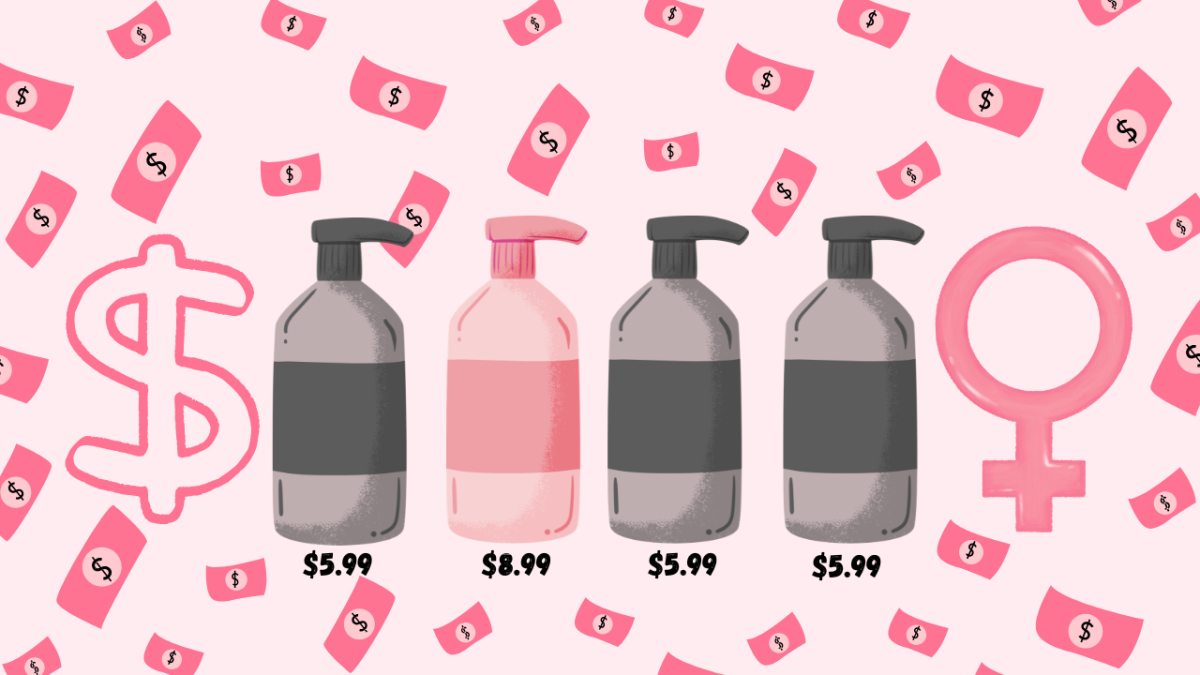
It might be Women’s History Month, but gender-based discrimination still exists today in commercial gender based pricing, such as the “pink tax” and the “tampon tax,” scamming women out of their money and deepening economic inequality for female consumers.
The pink tax is not an actual government tax on female consumers; it refers to the extra fee charged for certain products and services marketed to female consumers compared with those marketed to male consumers. This gender-based discriminatory tax was first researched in the 1990s, and the term’s name comes from the fact that most of the affected products are pink.
Recently, when I was shopping online on Amazon, I came across an example of the pink tax on deodorant. The products below were identical in brand and function, but differed in price, amount, and even ounce.
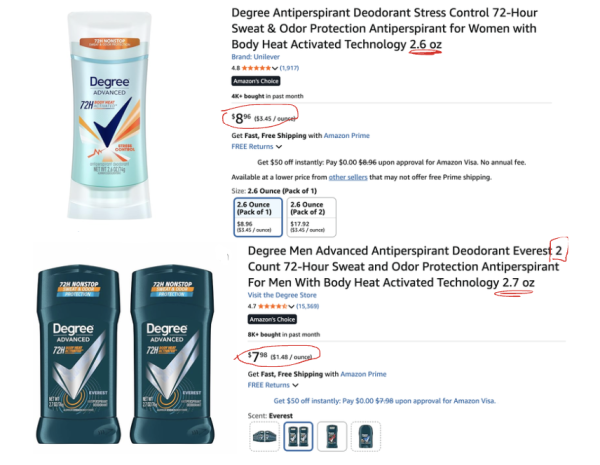
The single woman’s deodorant contained 2.6 ounces of product for $8.96, while the two men’s deodorants contained 2.7 ounces of product each for a total price of $7.98. The exact same price and almost the exact same ingredients but for more than double the amount of product.
When I compared the price per ounce, the men’s deodorant cost $1.48/ounce, while the women’s deodorant was priced at $3.48/ounce, more than double the price.
Although this was not the first time I have encountered the pink tax while shopping, this time it surprised me because the deodorant labeled for women wasn’t even pink. Despite what the name suggests, the pink tax affects many products that are not pink in color.
The cost of living is already high, and now it’s even higher for those who identify as women, all because of corporate greed and marketing.
The gender segmentation of consumer markets, in which products are marketed to men or women, allows companies to justify charging higher prices for products marketed to women based on their distinctive packaging or branding, thereby exploiting the perception of femininity as a marketable attribute.
Additionally, historical gender roles and expectations about personal care and hygiene contribute to the pink tax, as women are often expected to spend more money on appearance maintenance.
Studies show that women pay, on average, 7% more for products overall and 13% more for personal care items such as shampoo, razors, and deodorant than men, when the products are almost always identical in function.
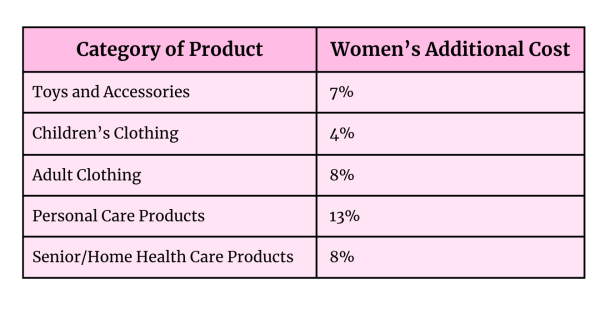
This ‘tax’ has many long-term effects on female consumers, costing women, on average, more than $2,381 per year for the same goods and services as men and approximately $188,000 more over a lifetime.
According to the American Civil Liberties Union (ACLU), women still make just 78 cents for every dollar earned by men. When women earn less but pay more for consumer goods, economic inequality becomes even more pronounced.
The pink tax is not the only financial burden on female consumers; the tampon tax, which refers to state sales taxes on menstrual products such as tampons and pads, also affects female consumers. Because menstrual products are not considered essential goods, they do not receive the same tax exemptions as items such as canned foods or prescription medicines.
This tampon tax might be even worse than the pink tax, as it makes menstruation, a natural biological process that 171.6 million women experience, a major financial burden.
The tampon tax contributes to what is known as “period poverty,” where the inability to access or afford menstrual products affects 1 in 4 students and 1 in 3 low-income women in the United States.
Across the country, an estimated $130 million in sales taxes is still collected annually on period products.
Taking into consideration that women have to buy more personal hygiene products than men, we should be given discounts instead of being taxed.
As of January 2026, 32 states have removed sales taxes on menstrual products, whereas the remaining 18 states continue to treat them as taxable goods rather than necessities. These sales taxes on menstrual products range from 4% to 7%.
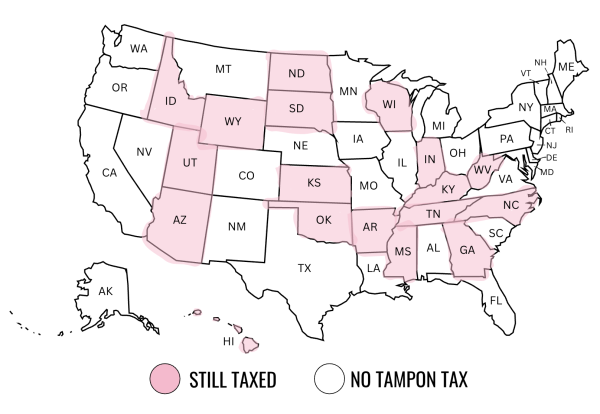
Thanks to advocacy efforts, legislation is underway to eliminate the tampon and pink tax. But for now, unfortunately, women and girls should shop gender-neutral and be aware of these discriminatory taxes until we finally see the day when women and girls will not be inequitably taxed just because of their gender identity.
As a female consumer, each time I shop, I begin by comparing prices of similar products in both men’s and women’s sections, and sometimes end up purchasing the ‘men’s’ product.
However, this should not be the case.