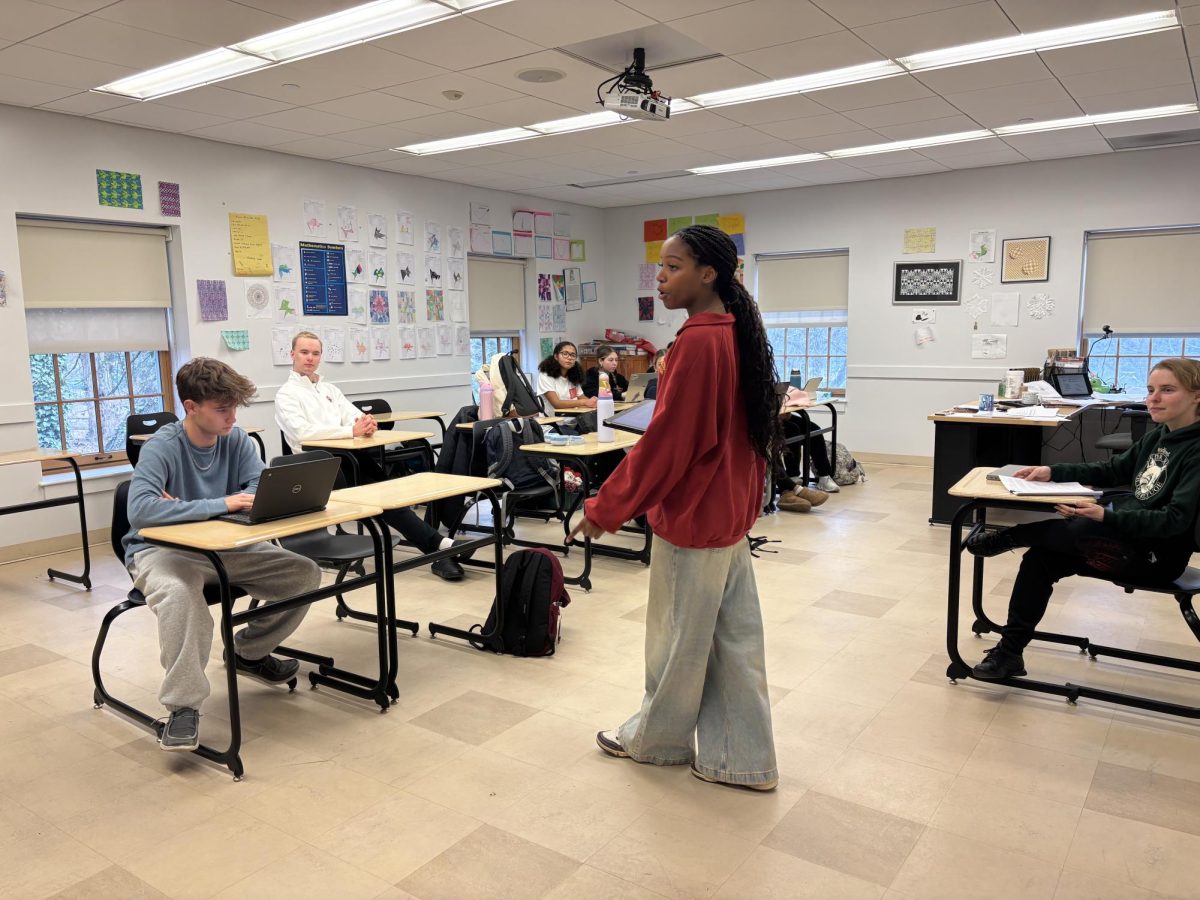
The first-ever student-led mock trial minor course team has faced both victories and losses during their first year competing.
MFS’s Mock Trial minor course team recently competed in their first few competitions, all three of which took place at the Burlington County Courthouse. Their first competition occurred on January 27, and the second on January 29; they placed first in both. Their third competition occurred on February 3, where they suffered their first loss. Their final competition occurred on February 5, where the Mock Trial team ended their season in a loss.
According to Arzu, since the class is new, there aren’t any firm plans to continue competitions for the entirety of the second semester. The only way the team would have continued to compete is if they had continuous wins in their competitions and would therefore have qualified for state competitions.
At the start of this school year, Upper School students Chloe Marshall ’26 and Olivia Arzu ’27 worked with Upper School math teacher Emily Provine to create a Mock Trial minor course in the A1 block.
Marshall explained that while she was unable to participate in the Mock Trial course due to scheduling conflicts, she was proud of the work Arzu has put into the class.
“I’m so proud of how Olivia has stepped up and fully taken Mock Trial to the next level at MFS. From my understanding, she leads the class by herself now and, again, I couldn’t be more proud and happy for her and the current program,” Marshall said.
The Mock Trial club, previously led by Haila Desai ’24 and Chloe Marshall ’26, sparked Marshall’s interest in turning mock trial into an official class.
“Freshman year, I joined Mock Trial, and it was so much fun. I just had such an amazing time, and I think that it was the opportunity to be in an actual environment that felt professional really inspired me to want to help other people to join [Mock Trial],” said Marshall.
Marshall continued, “I had a lot of other responsibilities going on, but there was really no one else who was interested [in Mock Trial] going into my sophomore and junior year, so I tried my very best to keep [the club] up. I was also super inexperienced, [but] I knew that it would be so good for the MFS community and everyone would just be really good at [Mock Trial] and very competitive, like how Model UN is, so I wanted to make an effort to continue [the club].”
However, both Marshall and Arzu realized that to successfully keep Mock Trial a part of the MFS community, it would have to become an official class.
“The difference between a club and a class, specifically for Mock Trial, is that clubs don’t have a strict meeting time. I lead [UNICEF club], for example, and we can’t ensure everyone will attend, [but] Mock Trial is something [that requires] a solid team, which means you must have solid attendance every time. So instead of forcing people to come to a club, I wanted to make a class, because that seemed like the most effective way to go about it,” said Arzu.
Marshall also shared her experience with enforcing attendance at the Mock Trial club.
“Sophomore year, I would make a binder with full annotations and lesson plans for Mock Trial, but then people weren’t coming to the meetings very often and [nothing] was really working [to get people to come],” said Marshall.
Alongside this, Marshall also mentioned how Provine was also a large help in moving Mock Trial from a club to a class.
Marshall explained, “What happened was Teacher Provine [who’s] very good at mock trial, [and] would come to competitions with us [during my] freshman year, shared that they had a class in high school [with] a more formal setting where they were doing [mock trial, and] that really helped [their] whole group. So, I really think it was Teacher Provine who encouraged me to push for a minor course.”
“The club system here [at MFS] does not work well with something like Mock Trial, which [consists of] long hours of dedicated prep instead of students coming and out [of a club],” said Provine
Provine continued, “Eventually, Chloe asked if it would be possible to run [Mock Trial] as a minor course. I sort of agreed that that’s the only way that makes sense to do it. So I proposed it for this fall.”
Arzu, however, explained that a huge inspiration for creating this class came from her experience in middle school.
“I wanted to start Mock Trial because it seemed like an elective that people would take seriously. One thing that also really inspired me was the mock trial cases we had to perform in eighth grade. That was the most fun I’ve ever had … I really liked the mock trial experience and that excitement that came with it,” said Arzu.
Once the class was officially created, it met during the Upper School A1 minor course block. Students had varying opinions when first hearing about the new class.
Anshi Reddy ’28 shared, “When I first heard about Mock Trial, my initial thoughts were that it was something new and exciting. [Mock trial seemed like something] that I would get to learn about and try and eventually, hopefully, like it.”
However, Charlotte Ostroski shared that her initial thoughts were very different from her current stance on the class.
“I went into the first class being like, ‘I don’t wanna do [this], I think I’m going to drop out.’ Then later that day, we had Mock Trial, and I actually really enjoyed it,” Ostroski shared.
Being student-led didn’t seem to have an impact on the performance and engagement of the students within the class itself.
“I think the fact that it’s led by one of my peers is interesting but also really helpful. It makes engaging way easier when it’s [led by] someone who’s around your age, so raising your hand or answering questions turns out to be a lot easier because you’re talking to someone you can relate to,” said Reddy.
Ostroski also pointed out that she didn’t notice a significant difference in the dynamic within Mock Trial [compared to my other teacher-led classes], despite being student-led. She also noted that Arzu was very good at leading the class, and that definitely had a positive impact on the current dynamic between Arzu and her students.
Provine also noted that a lot of the students who are enrolled in Mock Trial, had full interest in being there, resulting in positive behaviors throughout the class.
“Everyone in Mock Trial really wanted to be in there. [It’s] like [when you’re] on a sports team when your captain runs a drill [and] everybody’s [participating] … that’s how it goes,” said Provine.
Arzu herself also had specific remarks regarding leading the class.
“I personally haven’t experienced any change in dynamic, considering the class is student-led. Everyone listens very well, and I’ve never run into any issues with people disrespecting me during class. I think a lot of that comes from being either an active or passive leader towards your peers. I’m having experiences leading my peers on the fencing team, so I think the overall experience is interesting,” she said.