This year, MFS launched its Global Certificate Program, the first of its kind in South Jersey. The program empowers students to explore global issues, engage across cultures, and develop into ethical and compassionate leaders in an interconnected world, according to an email announcement from Head of School Julia de la Torre.
Advised by US Math Teacher Larry Ottman, Global Scholars will receive a certificate from MFS, and the program will be reflected on their transcripts. The interdisciplinary program is rooted in Quaker values and the “A Compass for Our Future” Strategic Plan, which emphasizes making an impact beyond the classroom.
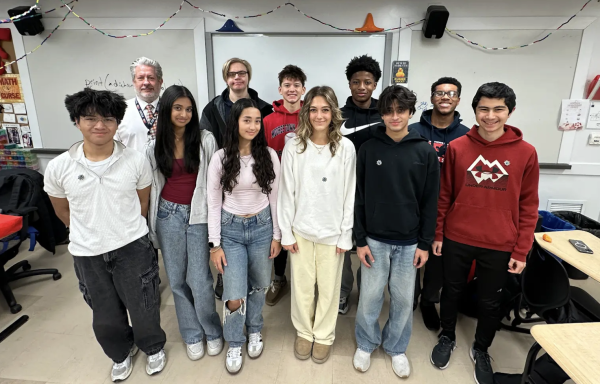
This year, ten sophomore students applied, and all of them received admission to the program. The inaugural cohort includes: Noah Hasni ’28, Maya Trivedi ’28, Zoe Dasgupta ’28, David Will ’28, Jack Anaya ’28, Connor Hehn ’28, Nolan Philips ’28, Nolan Youssef ’28, Rayyan Ansari ’28, and Paige Kochan ’28.
These students will spend two and a half years fulfilling global coursework, participating in an international Intensive Learning program, engaging in a globally-focused Capstone program, conducting service on an issue of global significance, and culminating in a portfolio and presentation.
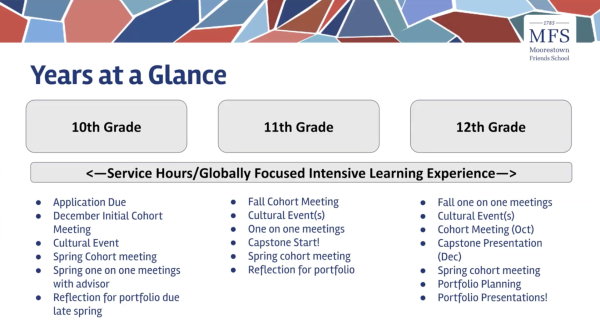
The program was announced on October 1 via email, followed by an information session and Q&A period on October 23. The program held an introductory meeting on December 5, where prospective members began by sharing a “cultural artifact” such as clothing or jewelry and its significance to their identity, according to Dasgupta. The students also discussed an article about Gen-Z activism on social media and researched youth-led protests.
The program began in January, where participants started by learning about what it means to be a leader in global dialogue.
As members of the Institute for Global Learning, MFS was inspired to create the Global Certificate Program, drawing on their research into other global learning certification programs.
Other schools’ global certificate learning programs that immerse kids in thinking across their curricular and extracurricular experiences have students who end up selecting majors that may be tangentially related to global studies.
“Students are going deeper, further, and sooner in college, in pursuit of studying abroad and [learning about] global issues,” de la Torre said in the info session.
“Some schools approach the program as a checklist, which is what we’re not doing. A program like this opens up pathways for kids in ways that just get them thinking about their role in the world much sooner,” she added.
As the program advisor, Ottman provides mentorship and support for each student’s unique journey through the program.
“Over the last several years, since I started leading Intensive Learning programs, I’ve become increasingly interested in helping students develop their skills and [investigate] having a broader, global perspective on issues that they encounter in everyday life,” Ottman said.
He elaborated on personal global connections.
“The overall biggest thing was that I adopted my younger daughter from Vietnam. My wife and I spent about three weeks in Vietnam going through that whole process, and that whole experience of just seeing things from a completely different perspective was life-changing,” he said.
Ottman also received his own global certificate over the summer through the Global Education Action Committee, where he traveled with other teachers to the Galápagos Islands for several weeks. To receive the certificate, he had three-hour Zoom meetings where teachers discussed what it means to be “culturally sensitive, culturally competent, [and] culturally aware” by discussing bias and perspective. He also had to complete assignments such as reading and reflective responses.
Ansari decided to apply because he thought it would allow him to “further pursue [his] existing ideas for a Capstone project with a few modifications.” Ansari is interested in health policy, and the global setting of the program aligns with his interest in incorporating global law into healthcare.
Philips said he thought it would be a good way to “show colleges and universities how [his] interests can align to impact on a wide scale.” While Philips did not have any personal connections to global education, he mentioned wanting to build a bridge between small-scale and wider reach projects, such as his charity fundraising for sick children at the Ronald McDonald House.
Kochan was drawn to the service aspect of the program because it “offers a lot of ways to help people while also learning about their culture and experiences.”
Following the info session, the application was open for sophomores until November 10. Application questions ranged from prospective students’ interests to reflecting on United Nations Sustainable Development Goals, exploring Quaker values through a global lens, and the characteristics of an exemplary global citizen.
Students discussed personal stories and interests in their applications. Philips wrote about how he learned about Chinese folklore through his Chinese friend to show cultural curiosity playing out in the world. Kochan wrote about wanting to learn more about other cultures and communities on a global scale through community work.
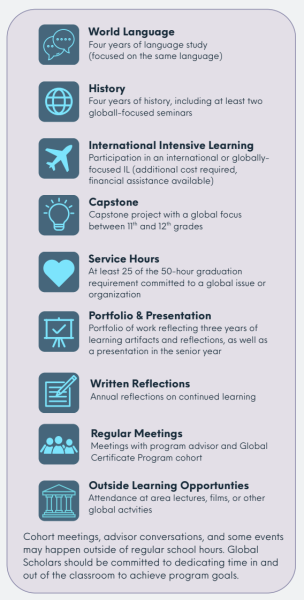
Some of the requirements for the Global Certificate Program impact course selection and activities, such as four years of language study, four years of history, and half of the 50-hour service requirement committed to a global issue or organization.
Philips originally planned to take both Advanced Placement (AP) World and AP US History during his junior and senior years. Now, he has to decide between the two AP classes because he does not want to add a sixth course to his schedule in junior year, as the AP courses do not fulfill the two globally-focused seminars requirement. He plans to take one AP class in his junior year and one of the required history seminars in his senior year.
“I’ve always wanted to take four years of history, but I wish the requirement[s] were more lenient,” Philips noted.
US Director Noah Rachlin explained during the info session that “the feeling, in conjunction with the History department, is that [AP World History and APUSH] is much more oriented towards a survey study of world history, rather than the deeper study and type of thinking and engagement with content that we’re trying to promote and support student development of.”
Kochan acknowledged the impact of the language requirement on her course selection.
“I was not originally planning to take four years of Spanish, but this program changed my plans. It gave me a chance to really think about the benefits of taking four years of language, and I believe taking four years of Spanish will have a very positive impact on my future and will be helpful in ways I wasn’t originally thinking of,” she said.
Anaya is most excited about the different cultural events that Ottman listed during the info sessions. Some options include lectures, local cultural group events, concerts, symposiums, online meetings with experts or alumni, intercultural dialogue with other independent schools, or local ethnic restaurant gatherings.
In the info session, Ottman said that some activities, such as the portfolio and the cultural activities, are “intentionally left open-ended … so students can have the opportunity to organically be involved in that.”
When asked about applying the Quaker lens to the program, Ottman said, “We’re always looking at things from a Quaker perspective. More concretely, we decided that students should have to dedicate half of their service hours to doing some form of service with an organization that has a global focus to it.”
“This is very much version one of this program. We want to get feedback from students as we roll this out, and see what resonates for kids. We’re basing this off of models we’ve seen from other schools and making it uniquely our own,” said de la Torre in the info session.
Ottman reflected on what he was most looking forward to.
“I’m excited to get the group together and develop a small community of people who are like-minded and hungering to learn … we can take it in a direction that most interests the students involved.”