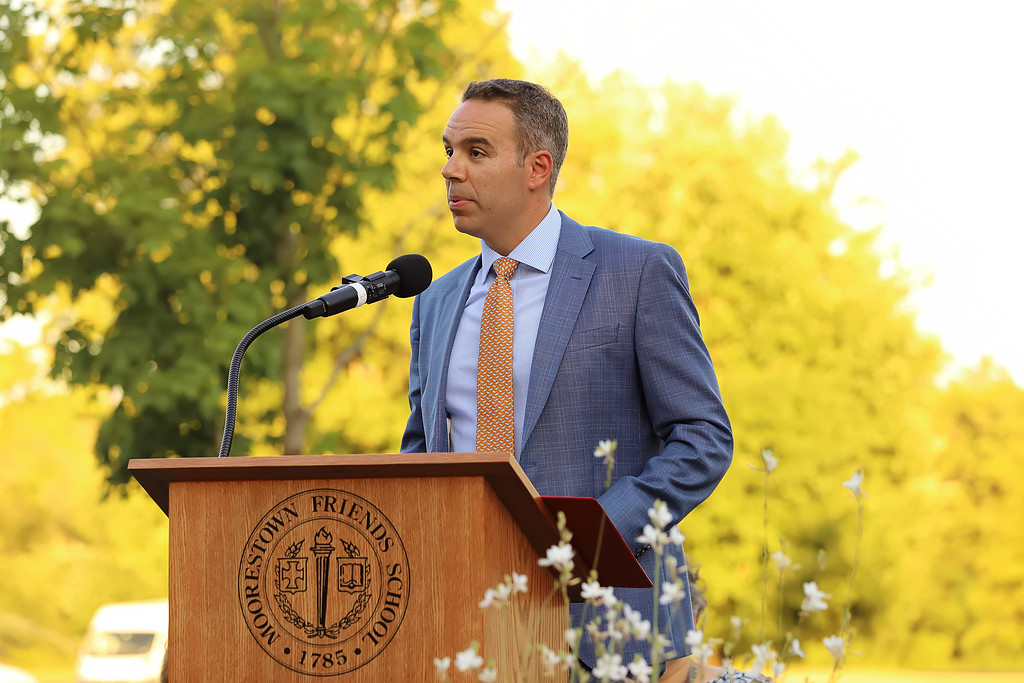
After spending six years as the Upper School (US) Director, Noah Rachlin is departing MFS and stepping into the role of High School Director at The Dalton School in New York City.
Rachlin left his position as the High School Dean of the University of Chicago Laboratory Schools to join MFS as US Director in March of 2020 during the pandemic.
“That whole first year was a complete blur and was really odd because I basically couldn’t spend time with people; I was just in my office on the computer all the time, and that’s just a really bad way to integrate into a community,” said Rachlin.
Despite arriving at MFS in “the oddest of circumstances,” Rachlin was able to connect with people as the pandemic subsided through his administrative role, as well as being the AP U.S. History teacher, filling in as the Interim PE/Health Department chair, teaching several minor courses such as “What’s Next?” and advising Model United Nations throughout his time at the school.
“In the year [following the pandemic], I have tried really hard to work collaboratively with faculty colleagues, students, and families, in ways that hopefully try to help us as a program … keep getting a little bit better,” he said.
Middle School Director Maxwell Bogaert, who connected with Rachlin over their New England background, noted his admiration of Rachlin’s “vision and programming.” During his time at MFS, Rachlin has worked on initiatives for grading equity, the cellphone policy, and the student-choice scheduling, which Bogaert described as “really innovative.”
“He’s got a very, very good sense of humor, and he’s just so smart … He always strives to make the school better; he never stops at [being] good enough,” said Bogaert.
According to Rachlin, the driving force behind his work is a commitment to building relationships with everyone in the community.
“One of the key ways that I think you [form connections] as an administrator is to be visible and to be present … For example, the first year after the pandemic, I joined practices for the varsity sports teams … I tried to think about things like that … to be able to say hello and be present,” said Rachlin.
Rachlin highlighted two things that he will miss the most about MFS when he leaves. On a professional level, he explained how the school’s “Quaker identity gives [the community] a North Star” that presents itself in many ways.
“When I talk to [new] students who have come through on a visit because they’re thinking about coming to MFS … nine times out of 10 the first thing they say is ‘everybody’s so nice here’ … I think when you’re a part of this community, you have this understanding that it’s a little bit different here, and I think that that is really special,” he said.
As a Lower School parent on top of his role in the Upper School, Rachlin also had a more personal reason for missing MFS.
“Both our children now, this year, for the first time, are in the Lower School, and there has just been so much warmth,” he said.
For Rachlin, the decision to leave stems from both a desire to be closer to family, many of whom reside in New England, and also an effort to grow and improve in his field.
“[The Dalton School], for example, has more students than MFS in their high school, … so it represents a new challenge and opportunity that feels professionally exciting for me,” said Rachlin.
Aani Desai ’22, who took Rachlin’s AP U.S. History course in her junior year and a couple of minor classes with him as a senior, noted Rachlin’s ability to bring out the best in his students.
“He had really high expectations, especially in AP U.S. History … At the beginning of the year, [those] high expectations [felt] really frustrating and out of reach for me. But then, as we sort of went through the year … I realized that actually … he was doing it because he believed in us and that he saw something in us that we didn’t [see] ourselves yet,” said Desai.
Rachlin’s influence and mentorship have inspired Desai to pursue teaching after she graduates from undergraduate school this year.
“Mr. Rachlin was and continues to be an important mentor in my life … I think having that supportive adult presence has … definitely allowed me to sort of go through high school knowing that no matter what, I had someone looking out for me, and I had someone in my corner, and that completely shaped my life,” said Desai.
Cloud Blackburn ’25, also in Rachlin’s AP U.S. History class during their junior year, recalled Rachlin’s determination to connect with his students authentically.
“Whenever I would step into his office, it was just a welcoming place. He had his candy bowl that we would walk in and grab from and have conversations,” said Blackburn.
Ben Buchdahl ’26 attributed Rachlin’s ability to connect socially with his students to “working with a bunch of different kids and [having] kids himself.”
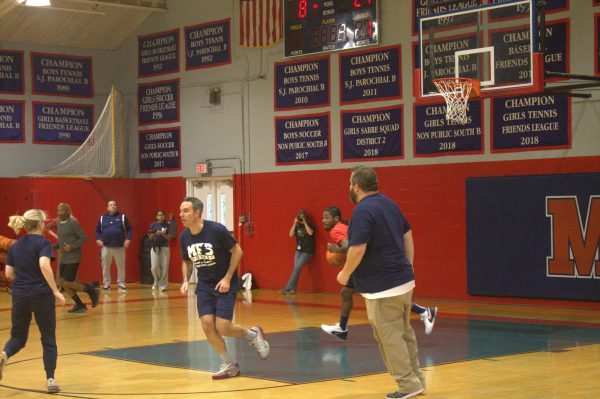
While Buchdahl couldn’t narrow down his interactions with Rachlin to a single favorite, he appreciated the short, sometimes “weird” conversations that “come at random times.” Buchdahl recalled going into his office with Jaiwant Singh ’26 earlier this week to talk about edamame.
Willie Didie ’26 has also built a very close relationship with Mr. Rachlin, often eating lunch in his office to talk.
“I think he’s somebody who every educator should aspire to be like. The relationship that he’s built with me has been extremely impactful and made my time here a lot more enjoyable,” said Didie.
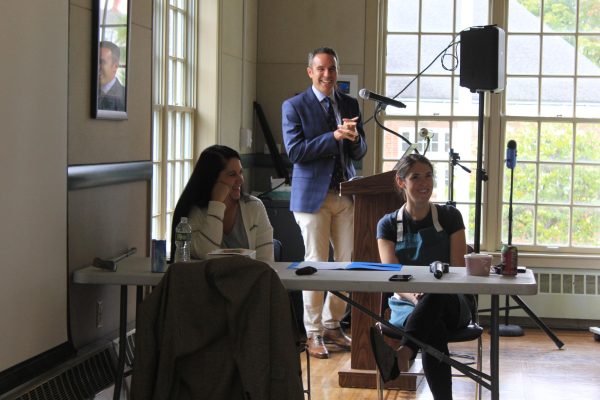
Will Miller, US Dean of Students, arrived at MFS a year before Rachlin did, and described their relationship as collaborative.
“[We are] understanding of each other’s approach and philosophy to not only education, but also the way in which we develop students … and also the way in which we think about building culture and empowering students to be able to not only make decisions about their academic programs, but also about how they experience student life,” said Miller.
He described Rachlin’s method of making connections as “seeing students in the in-between spaces” and has observed him forming positive relationships with US students.
When asked to recount a favorite moment with Rachlin, Miller could not narrow it down to one.
“If you were to ask him, he would tell you that I’m the one person [who] sees all of him,” said Miller.
He continued to say, “There may not necessarily be one moment that sticks out, but I think as a collective, what I’ve appreciated is being able to see him as a human and not just as a colleague. And it’s been six years of working together to be able to develop that relationship in a way that I can see him and he can see me.”
Rachlin is also famous for his “dramatic pauses” during speeches. Those quirks, along with memorable moments during assemblies such as his first day of school speech in 2024, where he showed himself jumping into the pool with his family, have made him unique as an administrator.
“I watched him give the faculty speech at graduation, and it just really stuck with me because it’s unusual for an US Director to be selected by the students. So that told me what the kids thought about him,” said Bogaert.
“Obviously, [I came into] freshman and sophomore year, and [I was] a little scared of him. But … I connected with him more and understood that he is a real person outside of work,” noted Buchdahl when discussing his “joking side.”
Miller recognized Rachlin’s analytical perspective as a reason why he is unique as an administrator.
“He has this unique way of zooming out, even out of being Upper School Director, to shed light on a particular thing in a way that allows us to … understand it better. That’s something that I think I would miss,” he said.