Spring sports season is well underway at MFS, and many student-athletes are balancing playing competitive sports at MFS and high-level club commitments. For students competing at high levels, success and college recruiting opportunities are increasingly tied to club programs such as Amateur Athletic Union (AAU), MLS NEXT, the United States Tennis Association (USTA), and others. The role of high school sports, not just at MFS but in high schools across the U.S., is shifting.
In many common high school sports offerings, only a small percentage, such as football and track, are directly tied to college recruiting. The majority of competitive sports and athletes are only seen by recruiters through club or out-of-school commitments. In addition, these commitments are almost year-round dedications, and, in certain circumstances, can limit your participation in high school sports.
An article by the Next College Student Athlete (NCSA) states that “club sports are offered year round, making it great for athletes to consistently focus on skill development, while also giving college coaches more opportunities to evaluate athletes during competitions.”
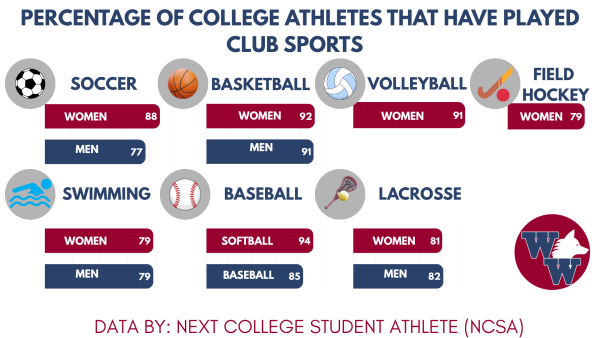
As the importance of club sports grows, many students are beginning to understand and feel the shift firsthand.
Dean Simpson ’26, an athlete for both MFS soccer and a local club soccer team, Medford Strikers, said, “For recruiting and your future, high school sports are pretty insignificant.”
“Nobody really looks at it. You’re not playing at a level where people are getting recruited at a high level, and you really need to focus on the club to make it to the next level,” he added.
Though clubs have become increasingly important, making many high-level athletes like Simpson believe it is the only competitive option, US Athletic Director Isaiah Coleman said high school athletics still provide experiences and opportunities that club programs often cannot.
“If a school is looking for a talented athlete, they will find you regardless of whether you are on a high school team versus a club team,” Coleman said. “If you’re making waves, if you’re training, if you’re putting in the work and effort behind the scenes, recruiters will know.”
But the importance of clubs deeply varies from sport to sport, most notably football, track, and basketball.
“I think it all depends on the sport. I think it’s very sport-specific to say club sports are better than high school sports,” Coleman said. “I’m not at all knocking the benefit of playing on a club team because I think there is more exposure. I think you may be put in front of scouts or recruiters differently than you would playing for your high school.”
The growing emphasis on high-level clubs isn’t just affecting one sport. In tennis, where rankings and statistics are tied heavily to exposure and national rankings, playing outside of school is essential, as seen by the NCSA Tennis Ratings & Recruiting Guidelines.
Tennis player Rafael Rauf ’27 said, “I would choose playing outside of school, for sure. For college recruiting, no one really gets recruited from high school tennis.”
“When you play outside of school, you’re still working toward a scholarship and getting exposure from colleges, so it feels more productive,” said Rauf.
While club sports provide a clearer pathway to college recruitment, they can be limiting, especially regarding the high school sports experience. Most athletes can pursue both kinds or at least have a decision on high school and club. However, certain leagues, such as MLSnext, which is a high-level youth soccer league, can restrict athletes from playing for their school entirely.
David Will ’28, a soccer player for the club soccer team Real FC, and plays in MLSnext, understands this tradeoff and will make this decision for the better exposure and opportunities that high school sports can’t offer.
Will said, “The competition is a big benefit. Also, recruiting opportunities and being around top-level players. You’re constantly playing with and against high-level competition.”
However, Coleman highlighted how restrictions from leagues such as MLS NEXT can impact school communities, team culture, and put the player down a pathway for only one sport.
“All of these coaches talked about the importance of a student-athlete who participated in multiple sports and not just specialized in one sport,” Coleman said. “We struggle sometimes with filling rosters and having enough students to compete. It’s putting us at a disadvantage a little bit, because we could be competitively way better.”
In addition, not all athletes share the same perspective as David Will, even within the same sport. For others, high school has something the club can’t replicate.
Simpson said, “I feel like MFS soccer is the reason I love the game. It’s the reason I continue to play, and being able to represent the people around you, represent your school, and be a leader for younger students is something that you’ll never really get in a club environment.”
In addition to the benefits of both school and club teams, the cost of the club becomes another issue that further exacerbates the difference between the two. Between cost, mental health impacts, and the major time commitment, the discrepancies between club and school sports continue to grow and are affected by socioeconomic gaps.
Statistics from the National Library of Medicine show that the total annual cost for a single child in club sports can range from $700 to $12,000, creating a pay-to-play circumstance for many athletes. Furthermore, roughly 70% of kids quit organized sports by age 13 due to the commitment and mental stress induced by high-level competition, and 16.9% of club athletes report mental health issues tied to their sport.
“This pay-to-play model is honestly hurting a lot of athletes and families who just may not have the means or the resources to be a part of some of these high-level programs,” Coleman said.
This divide between exposure and college success, and the relationships and experiences built within modern athletics, is a major choice for many athletes. While club sports may provide opportunity and exposure, for Jack Anaya ’28, a soccer and baseball player for MFS and club baseball player, high school sports often provide identity, community, and personal growth, with other students and coaches.
Anaya highlighted how “one of the most important things you can do in high school is join extracurriculars, mostly sports, because it shapes who you are in a way that clubs don’t. You constantly see your teammates around the hallways.”
“I take a lot of pride in representing my school. Honestly, I like it way more than playing club,” said Anaya.
Even still, several athletes, such as Anaya, Simpson, and Rauf, highlight the value of club commitments and their positive outcome in the long run, specifically for college and pursuing the sport after high school.
“From a pure college recruiting standpoint, I would go club ball,” Anaya said.
Despite their differences and trade-offs, both commitments build skills such as teamwork, competition, balance, and a sense of pride and representation for their school or club, which are vital for every athlete.
“I think club sports have really taken over because of college recruiting. But for students who want a different experience and want to play for something bigger than themselves, high school sports are still valuable,” said Rauf.
Balancing both sports commitments and school becomes a challenge for many of these multisport or multi-league athletes, particularly at rigorous academic schools such as MFS. Between practices, games, travel, and schoolwork, managing time becomes a constant challenge. Despite these challenges, student-athletes push through and pursue both paths, recognizing that though club sports may shape their future in athletics, high school will build bonds and create other opportunities.
“I don’t think high school sports will ever disappear,” Coleman said. “The fact that academics and character will always play a role means the people who know those things best are the people inside the schools.”